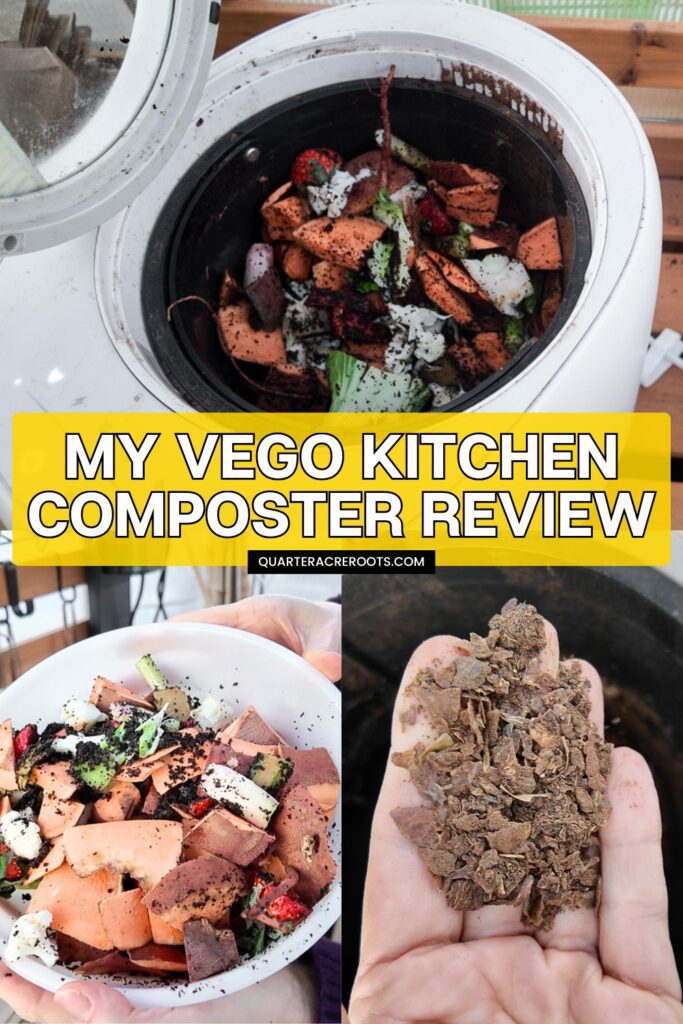
My Review of the Vego Kitchen Composter
If you’ve been around for a while, you know we compost a lot. We have three yard waste bins in the backyard, a double barrel compost tumbler, and a big bin behind my greenhouse. So when Vego Garden sent me their countertop kitchen composter a year and a half ago, I honestly wasn’t sure I’d need it.
But I use it a lot. It has become my winter composting solution here in zone 7, and I’ve been meaning to write about it for ages. They didn’t ask me to—I just genuinely have thoughts after a year and a half of real use. So here’s everything: how it works, whether it smells (spoiler: yes, it’s rotting food), what it costs to run, and who I think it actually makes sense for.
A look at the composter
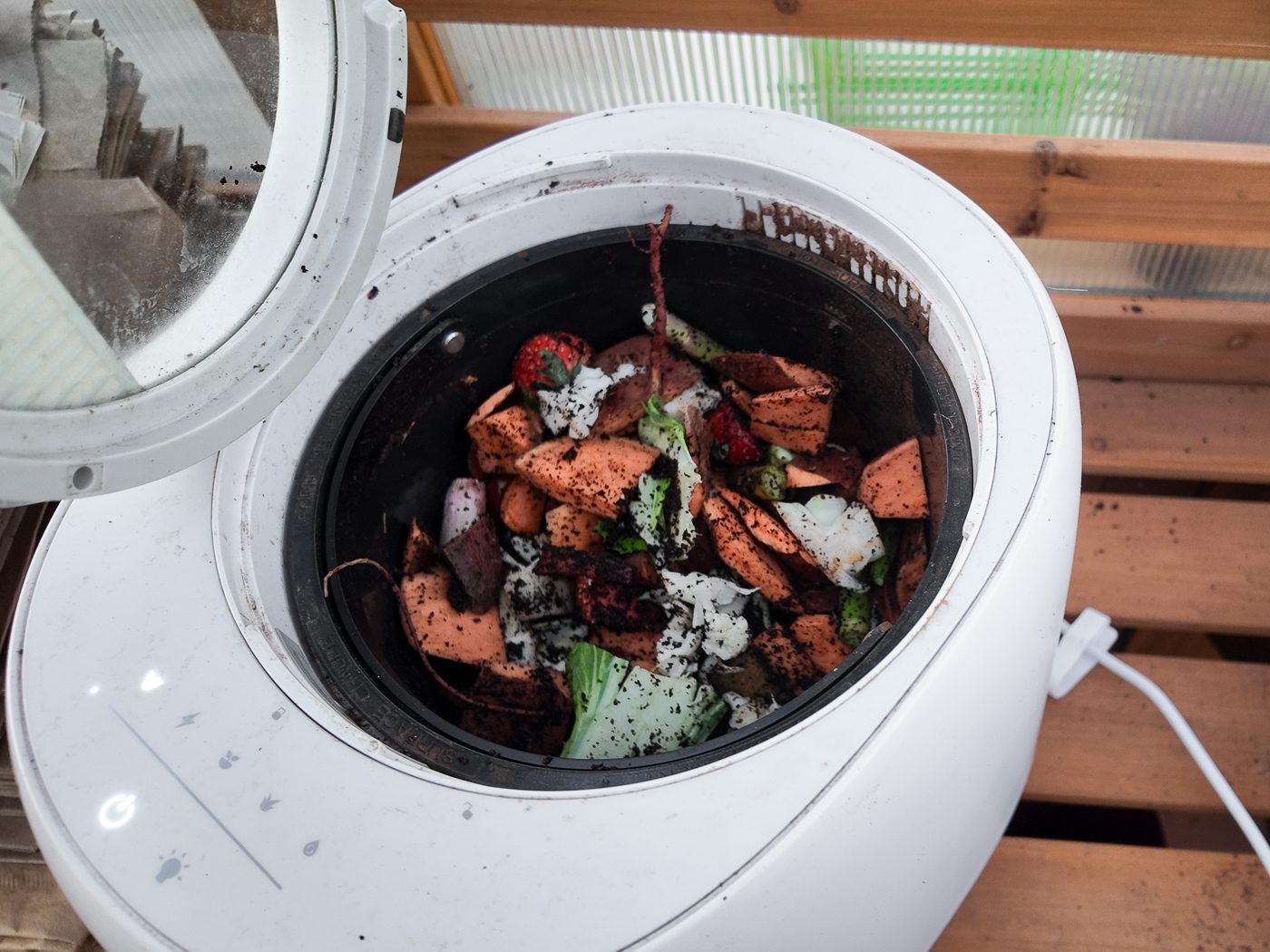
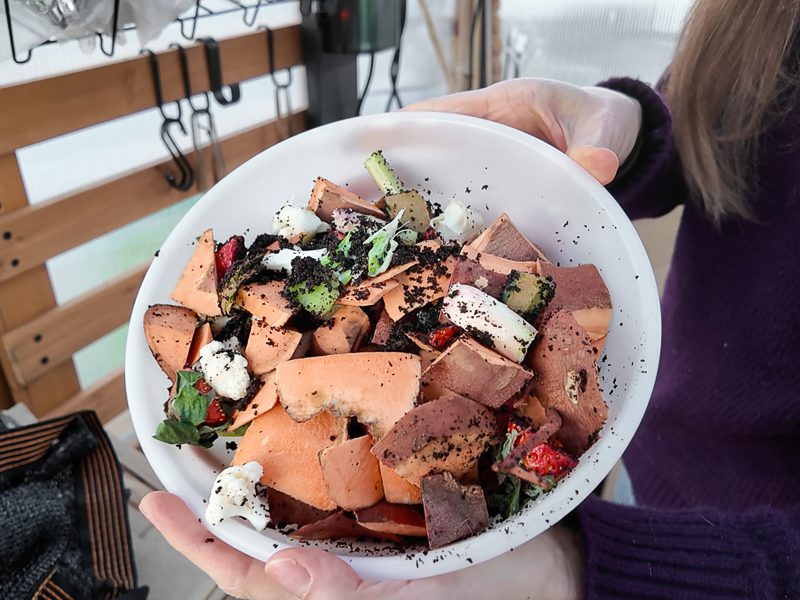
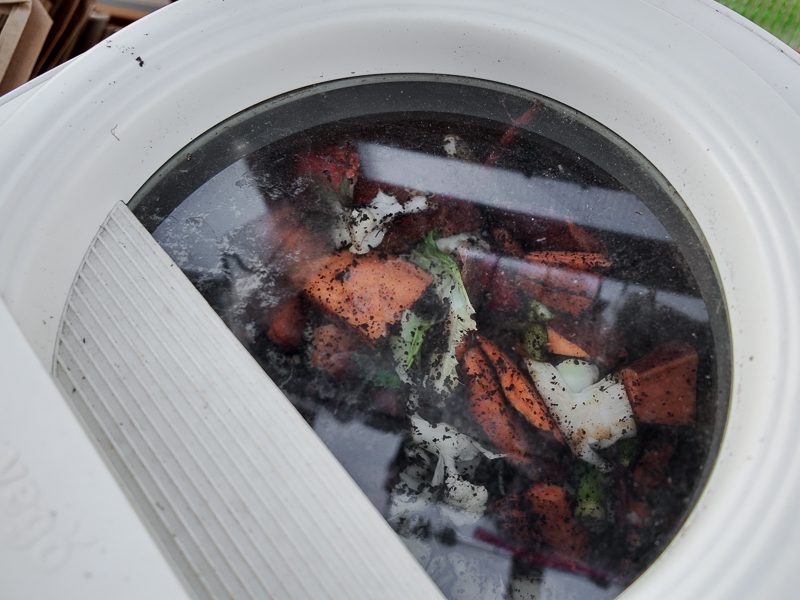
The setup is pretty simple. There’s a metal bucket inside that you lift out by the handle. That’s what you actually dump your scraps into. Down in the bottom of the bucket are blades that spin around and chop everything up while it runs. Then you pop the lid on and let it go.
I really like that you can watch the whole process happen. There’s something weirdly satisfying about seeing a bucket of scraps break down into a fraction of its original volume over a pretty short period of time.
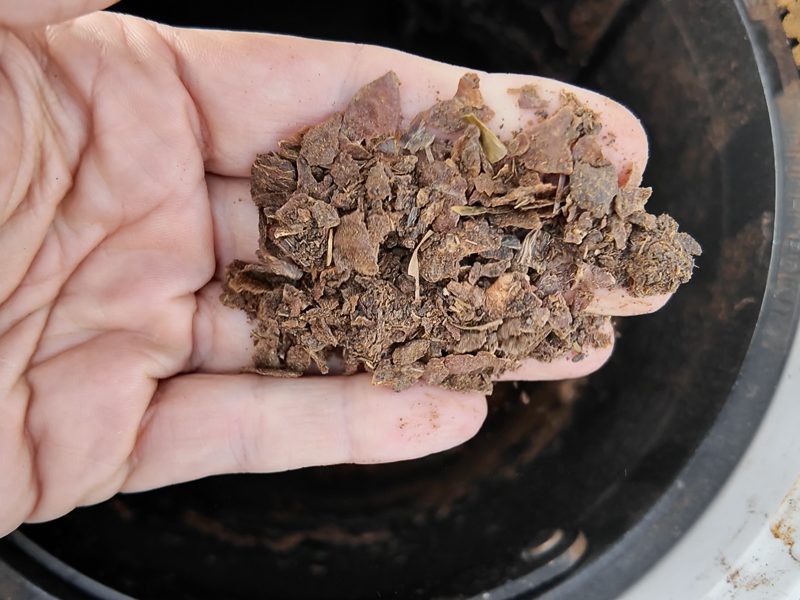
What you get at the end isn’t finished compost. It’s what Vego calls “meal”—a dry (but not dehydrated completely), crumbly, shrunken-down pre-compost material. And that’s really the point. In the dead of winter when my compost pile is completely frozen over, this thing turns a week of kitchen scraps into a tidy little bag of meal that I can…
- Bag up and save for spring
- Mix into some soil outside on a day that isn’t brutally freezing
- Dump straight into an existing compost bin to jumpstart it in the spring
That last one is my favorite. Come March, my bins get a big shot of pre-broken-down material and they wake right up.

The modes—and the only one I actually use
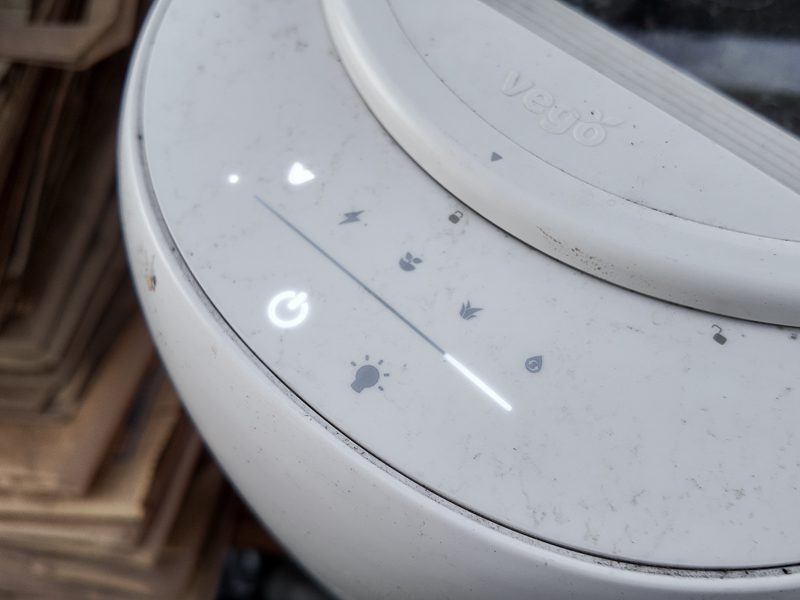
There are five modes on this thing. I’m going to be honest with you: I only use one. I use the Vego mode, the one with the little V on the button. It takes longer than the other cycles, but it doesn’t run as hot and fast, which means you retain a lot more of the beneficial microbes and good stuff in what you’re composting. That’s the whole reason I want compost in the first place, so it’s an easy call for me.
Why I skip dehydrate mode
There’s a straight dehydrate mode that uses super high heat. It’s fast, but that heat isn’t going to preserve any of the good stuff we actually want out of compost. I almost never use it. The only reason I can think of to reach for it is if you genuinely just need to shrink your waste down as quickly as humanly possible.
Does it smell? Well…it is rotting food
People always ask if composting smells. And this question kind of annoys me because smell is totally relative. Sometimes I’ll smell something and my husband won’t, or vice versa. Or we’ll both smell something, but it bothers only one of us.
So, yes. There’s a smell that goes along with decomposing food—that’s just a given. It’s rotting food. You’re going to have a smell. But I want to be fair here: it’s not a terrible smell. It’s kind of a sweet smell, honestly, and it doesn’t bother me much at all. The smell can also vary depending on what you’re composting.
But other people in the house may feel differently. My husband came home one day and said, “Smells like rotting food in here.” And I said, “That’s because there is rotting food in here. I’m composting right now.” 🙂
There’s a charcoal filter on the back that you can pop off and replace, and it helps a ton when it’s fresh. I have replaced mine maybe once in a year and a half. You should absolutely replace yours more often than that if you don’t want a smell—I’ve just been lazy about getting new ones.
My actual solution was to move it out of the house entirely. We have a small house, so it lives in there during the times of year when I can’t run it indoors with the windows open. I already have power run out there.

Why this makes sense for smaller spaces
I think this composter really earns its keep when it comes to smaller spaces. I think back to when we lived in apartments and would have loved to have a good composting solution. If you don’t have space to compost outdoors, this is a great solution! You just gotta have a plan for where the meal goes afterward.
Here are a few options…
- Feed it to worms! I want to do a whole piece on vermicomposting, because I’ve been loving our worm bin. A vermicomposting worm tower (this is the exact one I have) would also be a great solution for a smaller space. I can just dump the meal into my worm tower and make it an actual meal for them. The worms love it, and they’ll go through it so much faster than they would chopped-up scraps because it’s already broken it down into tiny pieces for them to eat and poop out.
- Keep a soil bucket going. Get a pot or a bucket of soil that just lives on your balcony or by your front door. Every time you empty the composter, mix the meal in and let it chill with the soil for a month or two before you plant anything in it.
- Top-dress potted plants. You can work a little meal into the top of your potted plants, too. It’s a similar process to mixing worm castings into the top of the soil, which is something I’m a big fan of with my houseplants instead of fertilizer. Just don’t go overboard. Too much and you risk shocking your plants with the material that isn’t fully composted.
The app is optional but cool
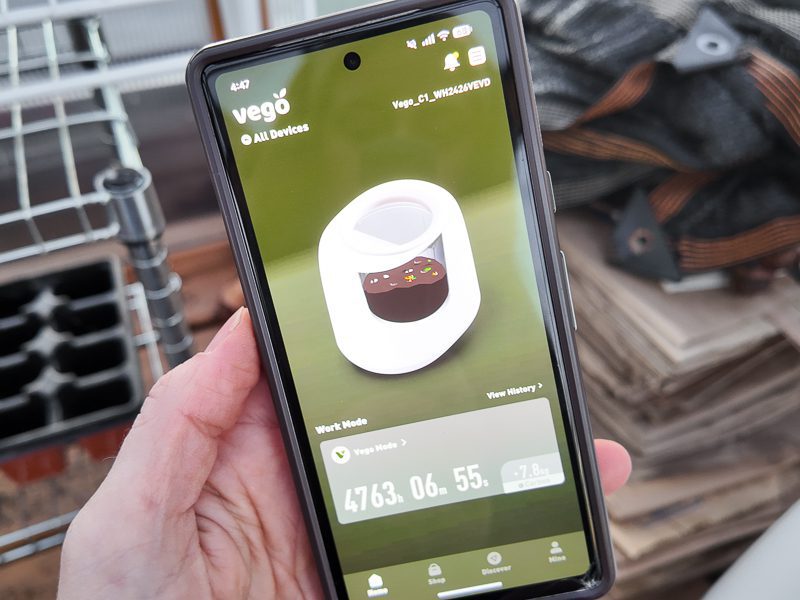
If you’re an app person, there’s an app you can link to the composter. I used it at first and then, like I do with most apps, I fell off using it—because you don’t have to.
It is genuinely cool, though. It tells you how long your cycle has been running, alerts you when it’s done (handy if the composter lives somewhere you can’t see it, like my greenhouse), and gives you some stats about energy and savings after each session.
If you get one of these composters, I’d download the app and link it up just to see if it’s your thing. But it isn’t required. Really all you have to do is plug it in, dump the scraps in, and hit go on whichever cycle you want.
Let’s talk about energy use
This is the comment I see every single time someone talks about a countertop composter: “What’s the point? You’re using all this energy. It completely negates the benefits of composting.”
That’s a valid concern, and I want to address it honestly. In a perfect composting world, we’d all have a huge space and enough bins to rotate—a started pile, a middle pile, a finished pile—all powered by the sun and nature. That’s not the reality for everyone. This makes composting accessible to people who otherwise couldn’t do it at all.
I couldn’t find energy numbers anywhere on the website, which honestly made me a little nervous. I was picturing a space heater sucking power for a full 24-hour cycle. So I reached out to Vego and asked directly. Here’s what they told me:
Regarding power consumption, our product uses between 0.3 kilowatts per hour and 1.5 kilowatts per hour, depending on the mode and the weight of the kitchen waste. This is equivalent to a 15 watt desk lamp running continuously for 20 hours, or a 1000 watt microwave operating for 1.5 hours.
Use that to make your own call! Personally, a 15-watt desk lamp running for 20 hours—maybe once or twice a month in the winter—is not a big deal to me for what I get in return. That’s a whole lot of food kept out of my garbage can during the months when my compost pile is a solid block of ice.
Wrapping up
I’m a big fan of this thing. I only work with brands I organically use and love, and Vego is genuinely one of them. Their raised beds are all over my yard, and you can see them in any of my garden tours!
That said, I do understand it’s expensive. If you’re interested, you can use my referral link here and code QAR5 for 5% off your entire order.
And if this isn’t in the budget, there are plenty of ways to keep the garden going cheaply. Check out my DIY In-Ground Worm Composting Bin…actually inspired by a Vego product that I saw and stubbornly thought, “I should just make that with one of the many buckets I have laying around.”
If you have questions about composting, let me know in the comments! Until next time, happy planting, or composting! 🙂